Aug 15, 2010

War on man

Hola mis amigos.
Anyone keeping up with Spain's news? article

Spain's beaches are swarming with jellyfish. Hundreds of swimmers have been stung along both northern and southern coasts in the past few weeks. This large aggregation of jelly is puzzling the locals, because they've never seen this before. To the north, the coastal waters are filled with Portuguese man-o-war.

For a quick rundown, the Portuguese man-o-war isn't really a jellyfish, it's a hydrozoan colony made up of individual highly specialized polyps that integrate to make up a larger animal. On the business end, the loooooong tentacles are outfitted with nematocysts. Imagine triggering thousands of tiny, toxin filled harpoons that shoot out to burrow into your skin. The man-o-war, I believe, is also the only animal on the planet that can produce carbon monoxide...which is the gas within the air sac. If I'm wrong about this, I'm blaming my invertebrate professor from college. A guy, that if you got him drinking enough, would stand up on a table and entertain you with a drunken, animated, amazing story of how he was attacked by an octopus.

I remember last summer on Pensacola Beach, more times than not I saw a purple flag flying over the guard stands. I've only been brushed by a broken tentacle of a man-o-war, and that was painful enough. To me, it felt like a burn. Like pushing your arm up against a hot oven rack. One of my good friends got it pretty bad a few years ago.

Gather round children, I have a little story about man-o-war stings:

A few years ago when I was still a graduate student, we were sent down to Key West to conduct some fish research. We'd go for a few weeks every January to sample King Mackerel from the commercial and recreational fisheries down there. I know, right? Somebody had to do it.

On this particular trip, I was working alongside my lab mates Kate and Mike. Since the charter boats would typically come in in the late afternoon, we pretty much had the days to ourselves. So on this particular day we decided to go snorkeling for a few hours over at Bahia Honda state park on Big Pine Key. The water there usually has decent visibility, and you can snorkel right off of the beach to some nearby patch reefs. I've seen some cool stuff out there, and on two occasions I swam right next to sea turtles. The water was nice, at least for everyone else but me. I wore my wetsuit, because I become an eight year old girl when it comes to swimming in cold water. To me, all water is cold water.

So, we started off of the beach and we noticed that there were alot of floating, blue, jellyfish looking things everywhere in the water. We looked at a few of them up close and Mike, without much doubt, had decided that they were these:

By-the-wind sailor, or sail jellyfish. Harmless.

they were actually these:

Portuguese man-o-war. Here comes the pain train.

which is not to be confused with him:

Man O' War, the top U.S. racehorse of our time.

We snorkeled around for awhile, dodging the blue floaties for fear that Mike might have been mistaken about his species identification. Wrong we were. so, so wrong. The current was flowing pretty good, and one of them floated right over Kate's hand.

I've never heard a woman scream like that. The sound shot fear up my spine. Honestly, I was looking for blood in the water. But when I saw Kate holding her hand, I knew what had happened.

We had to guide her back to the beach, because it seemed like she didn't know which way was up from the blinding pain. We rushed over to the dive shop, where the dive guide gave us some vinegar to pour on her hand. According to Kate, it didn't even faze the pain and it only made her hand smell funny. We were then looking for another option...

"Kate, do you uh.. want us to umm....?"

"Nobody is peeing on me."

Kate decided that as far as she was concerned the snorkeling was over for the day and she wanted to go home to nurse her wounds. Mike and I grabbed all of our gear and we all headed back to the van. When we reached the van (no joke), Mike and I became a little distracted by some topless, European sunbathers splashing each other in the water just off of the beach. The frolicking ladies were apparently unaware that they were in a Florida state park and not on a beach in the south of France. The entire scene took us a little by surprise. It also seemed to give Mike and I some sort of temporary deafness to Kate's pleads for us to leave.

"GET IN THE &%$#ING CAR AND TAKE ME HOME!"

The tone in Kate's voice snapped us out of our trance, and apparently foiled Mike's plan of going over to introduce himself and to welcome them to America.

So, if your friend is stung by a man-o-war and is freaking out:

First, remove any remaining tentacles (given). Then place tentacle on upper lip and call yourself Tom Selleck. I kid, I kid.

But, certainly try not to urinate on your friend...which they may even beg you to, midst their pain. Urine doesn't help, on any level, unless your friend really deserves it. Vinegar, Ammonia, Meat tenderizer...the typical arsenal of jellyfish sting remedies are all useless.

Use hot water. It denatures the proteins in the toxin, and eases the pain. Kate's pain immediately dissipated after she took a hot shower. I did some research, and there was a study done in Newcastle, Australia (Loten et. al 2006) using hot water to relieve pain from man-o-war stings.

But remember, certain remedies only work for certain species.

This is her hand after it happened. She still bears the scars from the contact 3 years later.


This certainly isn't the first time jellyfish have been a problem in the world's beaches and oceans. There have been reports over recent years about large increases in jellyfish populations off of China and Japan, the Gulf of Mexico, and the Mediterranean. In these areas, commercial fisherman trying to catch fish, end up catching tons of jellys along with it only to ruin their catch. Some companies are even developing new fishing nets to try to separate the catch.

Scientists and researchers say that we may have to get used to this because the factors contributing to the jellyness are pretty major. Increasing sea temperature from global warming, overfishing of the jellyfish's natural predators, and the increased pollution that provides nutrients to bloom jellyfish food...plankton. We're doing this to ourselves. The swimming pool is looking better and better isn't it?

I know what you're thinking. "Why is he talking about jellyfish? This is a fish blog."

Well, stop thinking.

Adios.

Jul 28, 2010

Indeed

The other day we set out from the ramps just before dusk. The sun was going down as we motored across the calm waters. The temperature was just right, there was light breeze that aroused and the sky was full of the brilliant hues of sunset. Ahhh, it was a perfect evening for romance.

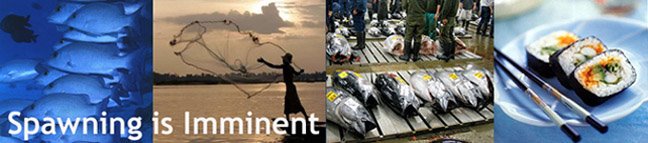
Spawning was imminent. (Cue up the Barry White)

I tagged along with some other fish researchers on an excursion for spawning spotted seatrout. They've been sampling and studying the bawdy little guys for several years now. As we rode out, they informed me that in the summer during certain moon phases, the seatrout will aggregate at night to get it on. I gazed up and sure enough, there was a full moon low in the sky. The ride wasn't long, and we reached an inconspicuous beach and came to a halt. We turned on an audio receiver to listen for the drumming of the males. Yep, they're calling in the ladies. Contrary to their name, spotted seatrout aren't in the trout family...they're members of the drum family. The males make a drumming sound by beating their abdominal muscles to their swim bladders. Apparently the females think this is pretty sexy, so they come a runnin for some lovin.

once you go trout...you don't holdout.

I jumped out of the boat into knee deep water while holding one side of a long seine net. The boat sped away to make a wide arch coming back into the beach. We brought the two ends of the net together and pulled in the slack. As the catch had become more and more concentrated, I could feel fish banging against my ankles. shut up.

We ended up catching around 40 large seatrout in a single net. According to my colleagues, this was a small catch...sometimes they catch up to 100 per tow. The bulging fish were loaded into the back of the mullet skiff for processing.

I was kind of bummed because it was too wet to bring my camera.

We took lengths, DNA samples, and checked for sex. This was the interesting part. To check for male or female, you have to put a little pressure on the stomach of the fish to check for hydrated eggs. And I found out that the more pressure, the more furiously the eggs spray out of the animal. As I'm wiping off eggs from my shirt, someone called out to the person recording data that the first fish of the night was "a female, running ripe". I've decided that most people would have been disturbed by this.

Jul 20, 2010

Fort Knox of Fish

Hey friends. It's been awhile.

I apologize for my disappearance from the land of blogging. While you were desperately holding your breath in my absence, I had some big life changes. I switched jobs and cities, so to my defense I’ve been a little busy with the adjustment. Ok, it was a long adjustment. I even missed the one year anniversary of my blog. Wow. It's growing up so fast....talking, walking, and still not potty trained.
I guess what sparked me to pick it back up again was a number of angry, bewildered people who confronted me. While backing me into a corner and with tear soaked eyes, they would ask:

“What Happened?”

“You stopped?”

“Why have you forsaken meeeeee!?

Ok, no tears… But more with a tone of confused disbelief. It was a little flattering. I thought only my mom read this. She's always been a fan of my work, and thanks for the potty training mom.

Another spark to continue my second-rate writing for you was a recent NY times article (link) which is a well written synopsis of an infuriating subject I’ve been following for some time now. The disappearance of the bluefin Tuna. The bluefin is critically endangered. The Atlantic and Mediterranean stocks have dwindled 72% in the past 40 years. So endangered in fact, it has joined the list of the ‘rarest of the rare’, its name is written alongside the charismatic notables: Polar Bear, Tiger, and Giant Panda.

Have you guys ever eaten Giant Panda before? You haven't?! Ohh my gosh, it’s delicious. I know a GREAT place up the road. It’s really expensive, and they only give you like, two pieces of it. We should totally order some teriyaki California Condor wings too. Two orders of the Black Rhino please.

It’s an oh so common occurrence to find a species to be endangered from pollution or habitat loss, but it’s another thing to drive an animal to extinction because it tastes like candy. Fish candy.

Ok, that doesn’t sound good.

Bluefin tuna is the pinnacle of sushi, and the world has been in a reckless love affair with the species for decades. The texture and taste of bluefin sashimi is supposedly unmatched. The biggest proponents of the tuna are of course, the Japanese.

typical day in happy Japan
Google always delivers. I'm sure you've read this here already, but I’m a huge fan of Japan. The culture is so unique. The ancient traditions, Tokyo lifestyle, the bizarre social norms. Not to mention the people are completely bat@#$% crazy. Japan is like an amusement park filled with Asian people. They’re full of contradictions, unfortunately, even down to their food.

I’m sure you’ve heard about the tuna auctions that take place in the enormous Japanese fish markets. But have you ever heard about the stockpiling of bluefin tuna? The Japanese, knowing that they’re partaking in a dwindling resource, have been rumored to stockpiling bluefin in massive warehouse sub-zero (-60 C) freezers. 50,000-60,000 tonnes of bluefin tuna are stocked every year in warehouses for use when supply runs low or out. That much bluefin could be worth 100’s of millions, if not billions of dollars. How long would it last the country's diet? Probably a year and a half. I bet they'd have armed security detail around that frozen compound. Call it the Fort Knox of Fish.

The Japanese buy and consume 80% of the world’s bluefin tuna catch every year. If a typical sport fisherman off of the Atlantic coast would catch one, it’s immediately packed into a sarcophagus full of dry ice and on a plane to Tokyo. Spotter aircraft find fast moving schools of juvenile bluefin so tuna ranchers can corral them into floating pens out on the high seas and “grow” the fish back into port. Hook and line fisherman use electric harpoons to dispatch them instantly to avoid the fish tainting it's own meat with lactic acid.

Unfortunately, the less there are, the more valuable they become. This encourages increased illegal harvest. The risk vs. reward is more and more worth it, resulting in billions of dollars of illegal bluefin sales occuring every year. The failure of bluefin management is due to the fish's enormous range, wherein unregulated international fishing is taking place. The tuna crosses into many borders where people may not follow the regulations set by ICCAT (International Commission for the Conservation of Atlantic Tunas).

The high seas: where the laws are more like suggestions.

for shame...stop eating

Jan 13, 2010

Kung-Fugu

So, I slacked off over the holidays. Were you expecting more? You should know me by now.

Score! I got my new camera. It's been a long time since I had that giddy feeling while opening a present. I think the last time that happened at Christmas, I was opening up my G.I. Joe, Sgt. Slaughter battle tank when I was 8.

with kung fu grip. recognize.

Since I can't take a picture of my camera....with my camera. Here's a picture someone else took of it.


dope.

I bought the Canon T1i and the "nifty fifty", 50mm f/1.8 mark II lens. I didn't buy the kit lens because I was only going to upgrade anyway. The 50mm is really sharp. The build quality is a little eh, but the image quality for the price is fantastic. I'm ready to buy a zoom lens now. So after lots of homework, I'm thinking either the new Sigma 17-70 OS or the fairly new Canon 15-85 mm. I like to have the wide end for macro pictures (so I can take uber close ups of my belly button) and a little bit of zoom for some decent far off shots. I'd just like a sharp, fairly fast, walkabout lens. So any suggestions are appreciated, ah thank you.

I think I'll carry the camera along to Cocoa Beach next week. A few of us are going to the Artificial Reef Summit meeting. We'll be presenting some of our artificial reef research as well as getting to see some other talks. Should be a good time. I'll snap off some shots.

I guess I should talk about fish now.

You guys know about Fugu, right? Fugu is the Japanese word for puffer fish, and it's a very popular and notorious dish in Japanese cuisine.

But eating it is like playing Russian roulette. Fugu chefs are rigorously trained to cut the fish while avoiding certain organs (liver, ovaries) that contain tetrodotoxin. This neurotoxin is VERY lethal to humans. It's more potent than cyanide, and there isn't any antidote. It paralyzes all of your muscles, and while you are completely conscious you die of asphyxiation. What's even more crazy is if a customer dies from the Fugu... the chef must commit suicide with his own fillet knife.

This is why I love the Japanese culture. They're completely cracked.

If you're interested in dieing trying it in the states, New York would be your best bet. I've read that they're are only 17 fugu restaurants in the U.S. and 12 of them are in the big apple.

It's a very tasty fish, so people have been looking for ways to avoid the whole "stop breathing" situation. Recently, they've found it with a new farming method to produce non-lethal puffer fish for consumption. A Japanese aquaculture company developed methods to separate the fugu from tetrodoxin laden bacteria that it ingests. Article here.


Introducing, diet fugu light...

I think most of us would agree that taking the bullets out of the gun makes the whole thing less fun. There would be less enjoyment in eating it while knowing there is no risk involved. Plus you have the cultural significance of the dish. They've been eating this stuff for over 2,000 years!

And if I was an elite fugu chef after years of tedious training, I'd be coming after those scientists with my giant fugu knife.

Go Joe.

Dec 16, 2009

Every stomach is a big bag of Christmas!

Hey party people.

It's always a complete surprise. When I pluck a fish stomach out of its alcohol bath, the tenacious nerd in me says, "Man, I hope there's something really cool in here."

Well, I guess cool is relative. Most people would think finding a golf ball or a Yanni cassette in a fish stomach would be cool. I'm always hoping it'll be a really rare fish or crab species, or maybe see some cannibalism. Yes, some fish eat their own.

I was going to reference Soylent Green here, but I feel like 5 out of my 7 readers wouldn't get it. But................I'm doing it anyway. Tell them Charlton Heston...

IT'S PEEEEOPLE!

I've been conducting some fish gut analysis for the past couple of weeks. Gut analysis is one of a few methods to study the food web in an ecosystem. For our research, we're looking at diet of reef fish (snapper, grouper, porgy, triggerfish, amberjack) on artificial reefs compared with their diet on natural reefs. Fish stomach:

Accurate diet analysis requires a good knowledge of all walks of marine life, experience in taxonomy, and some creativity. To put it simply: It's not easy. Obviously, the stomach digests things....so, the diet items that you pluck out:
1. Aren't usually in one piece.
2. Sometimes don't even remotely look like how they should look outside of a stomach.
3. Are all mixed together in one giant gastric orgy.

So David Caruso, you gotta piece together the crime scene, rule things out, look for distinguishable characteristics, classify things as specifically as possible (even to species), and be 85% sure it IS whatever you're going to classify it as. Any less sure, isn't sure enough. And take off your sunglasses, ginger.

Here's a picture of Joe doing science:

As we go along, we've taken some pictures of the more interesting things we've come across. But 90% of what we see is brown goo. Here are some of the highlights.

Rock Shrimp


Fish head. Most likely a Blenny.


Portunid crab claw


Isopod


Thecosomata or "Sea Butterflies". Just google it. Look up "sea kittens" too. Then laugh.

It also makes this work a lot easier if you're good friends with an invertebrate guy down the hall (Thanks, Alex). He knows stuff.

Somedays it hits me. I do weird things at work. But, it's actually pretty fun. BTW, I'm 85 percent sure that this post made you nauseated. And that's ok, because that's what I strive for.

Merry Christmas everyone.

Dec 2, 2009

Toilet humor

Sorry I haven't posted anything in a month. Honestly, there's been little time to write and little motivation on my part. However, aside from the Holidays coming up, time is now on my side and my motivation has never been stronger. Material is a little lacking, but hey....we're past that. I'll just keep posting about things you might not care about because you'll read anything, won't you?

I can't believe it's December already. Up until now, I've been very busy with field work so the time, she flies by. We're going to shut down field work for a few months, for the most part. This gives us time to catch up on laboratory work. And who wants to be on a boat in the middle of the Gulf this time of year? It's bumpy, cold, and wet.

That's what she said.

Pretty soon, Joe and I will be working on some reef fish gut analysis. BTW my right hand man, Joe is one of our technicians in the lab. We've collected hundreds of stomachs in the past couple of months from fish we caught hook-and-line. The stomachs have been pickled in formalin, so we'll be dissecting them and identifying/weighing the contents. So I'll snap off a few pictures and learn you something about fish diet.

Speaking of pictures, I'll be getting myself a new DSLR camera this Christmas. I'm thinking about getting the Canon Rebel EOS XSi. So that means more expensive toys for me to break, and better pictures for you to look at. You're welcome.

So...that's status quo. Oh, I wanted to end the post with a bang. A really gross bang. Here's an article about eating Escolar.


sweet oily revenge

The Escolar (or "butterfish") is sometimes labeled as white tuna in sushi restaurants. I've also seen it prepared in upscale seafood restaurants. The fish contains a high fat content, with a healthy portion of wax esters. These esters can cause anal leakage. Apparently, if you eat enough of the fish (more than 6 ounces), the wax esters pool up and seep out into your trousers.

The more you know.

Nov 2, 2009

Bag 'em and tag 'em

Last week we spent a few days in deep Louisiana at its southernmost port. Port Fourchon (pronounced, Foo-shon), wasn't exactly what I expected. As you drive up to it at night, it's lit up like a Christmas tree. You're thinking you're driving up to a fishing town, but you discover that it's an industrial metropolis. Helicopters always buzzing overhead, you're surrounded by the offshore oil industry. Apparently, this port supplies 16-18% of the US oil supply and produces over 90% of the Gulf of Mexico's deepwater oil.

When you drive into that port, you also realize that this is man country. Offshore oil workers, commercial fisherman, crew boats. I asked the captain of the shrimp boat that I was aboard:

"How many women do you think there are around here?"

He gazed over the Port Fourchon commercial docks.

"Maybe 5, and you'd probably have to pay for 4 of them."

This area of Louisiana is also a fishing mecca. Our mission was to go offshore to catch king mackerel and tag them with pop-up archival satellite tags to estimate their winter migrations. First off, let me show you the King of the Mackerels, courtesy of Diane Peebles.

Satellite tags have been in use for several years now, tracking movements of larger animals. Sea turtles, sharks, marlin, tuna, swordfish, and whales have been the guinea pigs of early satellite tagging studies. Now that technology has gotten things a little smaller, we can now attach the tags to relatively smaller pelagic fish like kings.

So here's what a satellite tag looks like:

If you think it looks expensive, it is. It's like strapping a $5,000 check to a fish and watching him swim off with it.

The tags log temperature, depth, and light intensity. Interestingly, the light data can be used to calculate latitude and longitude. After a predetermined amount of time, the tag detaches itself from the animal, floats to the surface, and then says hello to the satellite. The tag uploads the data to the satellite, and then it magically beams it to your email. That's right, magic...mind blowingly awesome magic.

Of course, bad things do happen. The animal can die, get eaten, or the tag can fall out. You just have to cross your fingers and hope he makes it. And if any of you find one of our tags, we'll give you $500 for it.

So to keep it short, we made it a few miles offshore in the shrimp boat. The seas were rough, but the boat took it well. We managed to catch, tag, and release 5 king mackerel with the sat tags. Things happened pretty quick once the fish got on board, so taking pictures was the last thing on my mind. Here's the only shot I got of us tagging.

The most important part of the process was to keep the fish as healthy as possible so it had a better chance of survival. King mackerel can stress or die pretty quickly if left out of the water even for a short time. As we released the tagged fish back into the water, we tried to encourage them to get moving again; so we would yell, "SWIM!! SWIM!!" "GO, GO, GO!!" "SWIM, YOU #$%&@*!".

I think that helped.

So kings, keep swimming. Send us a postcard from Mexico.